

Introduction
The workplace will be fair, safe, and respectful. However, not all workers in the United States will be treated equally by their employers. A few workers will experience a lack of fairness in the form of discrimination, harassment, unfair pay, unfair dismissal, or retaliation after reporting a violation. These situations can give rise to what we term workplace and employment claims.
In this guidebook, we will inform you of everything that you ought to be aware of regarding the workplace as well as workers’ claims in the USA in simple language. You will learn what such claims are:
- Legislation that protects workers
- Forms of claims that are available
- How these claims can be filed step by step
- Deadlines that must be adhered to
- Remedies that can be sought
- How workers as employers can approach these cases
This is a long, complete guide so that you have all the information in one place.
What Are Employment & Workplace Claims?
An employment or workplace lawsuit is where an employee brings an action against an employer for a violation of workplace rights. These rights are protected by United States state laws as well as by federal laws.
Such as:
- If a worker was dismissed due to his or her race, gender, religion, or age.
- In a case where an employee was not paid for overtime worked by him.
- When an employee on the job is being harassed, and an employer fails to act on it.
- Even when the employee qualifies, if an employer will not allow family or medical leave.
That being said, if an employer breaches labor or employment legislation, then the employee can bring a claim.

Key Acts protecting Employees in the USA
There are some significant federal laws that offer protections for employees. These laws pertain to certain workplace rights fields. The following are some significant ones discussed in simple words:
- Civil Rights Act (1964, Title VII)
Boss cannot treat you bad ’cause of your color, race, religion, sex, gender stuff, pregnancy, or where you’re from. - Age Law (ADEA)
If you are 40+ years old, your boss cannot say “too old” and treat you unfairly. - Disability Law (ADA)
If you got body or mind problem, the boss must give some help so you can work. - Equal Pay Law (1963)
A man and a woman doing the same job must get the same money. - Family & Medical Leave (FMLA)
If the baby is born, you are sick, or the family is sick, you can take some time off (no salary, but job still safe). - Fair Labor Standards (FLSA)
This one say boss must give a minimum salary, pay extra for overtime, and follow child labor rules. - Genetic Info Law (GINA)
The boss cannot use your DNA or family health info to treat you badly. - Safety Law (OSHA)
The boss must keep the workplace safe and healthy for workers.
These particular laws are administered and enforced by a set of institutions:
- Including the Equal Employment Opportunity Commission, more commonly referred to as the EEOC
- The Department of Labor, more commonly referred to as DOL.
Kinds of Workplace & Employment Claims
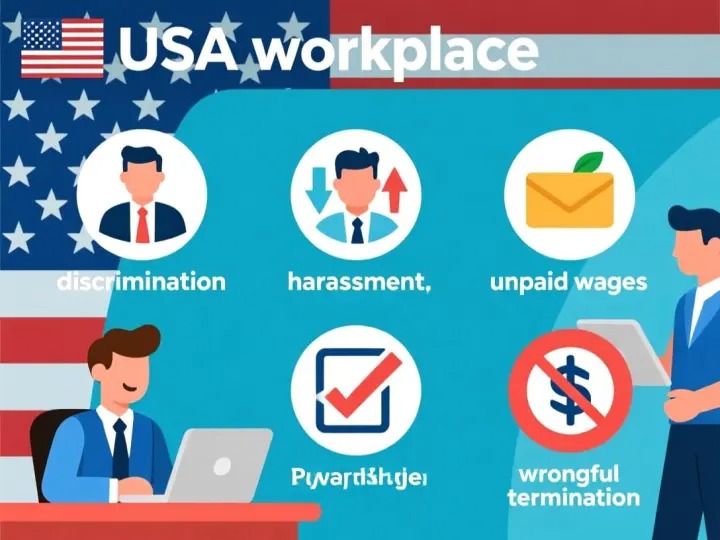
There are various types of claims that can be raised by employees. We will briefly describe the main ones with examples:
1. Discrimination Claims
When an employer harasses an employee intentionally on the grounds of race, sex, religion, age, disability, or national origin.
- Example: A qualified female is not getting promoted when men more unqualified than she get promoted.
2. Harassment Claims
These consist of hostile work environment cases as well as sexual harassment cases.
- Example: Unwelcome sexual advances by a supervisor, or routine offensive jokes by coworkers.
3. Wage & Hour Claims
In the event that workers receive inadequate pay under federal or state pay laws.
- Example: The worker will do 50 working hours a week but will receive no overtime pay.
4. Wrongful Termination
When an employee was dismissed on unlawful grounds, such as discrimination, retaliation, or in spite of an employment contract.
5. Retaliation Claims
When an employer disciplines an employee for reporting a crime or complaining.
- Example: He is demoted or fired when he complains that he was treated unfairly.
6. The Inability to Provide Necessary Accommodations
In the event that an employer will not make reasonable accommodations for a disabled person’s disability, pregnancy, or religious beliefs, it can create serious complications.
7. Violations of Family and Medical Leave
When an employer interferes with or blocks an employee’s right to FMLA leave.
8. Whistleblower Claims
Whistleblower employees reporting illegal activities, some more severe like fraud, as well as safety infractions, will receive some safeguards that will protect them against any kind of reprisal.
Whose security and assurancedo these particular laws truly provide and establish?
Not all workers are covered by all statutes automatically. Take the following example:
- Title VII typically covers employers whose total personnel number up to a total of 15 workers.
- ADEA covers employers that employ 20 or more.
- FMLA applies if the employer has at least 50 employees in a radius of up to 75 miles.
- Technically, every worker is protected by FLSA wage-hour legislation.
Covered classes are:
- Race and national origin
- Sex, gender identity, sexual orientation, and pregnancy.
- Religion.
- Disability (mental or physical).
- Age (40 and above).
- Genetic information.
How to File an Employment Claim: Step-by-Step
Guide Complaining in the workplace can actually be intimidating for many individuals, but do not fret, as there is an easy and easy-to-learn step-by-step process that you can abide by:

Step 1: Record Everything
- Maintain incidents on file in their entirety. Record the date, the time, the individuals involved by name, and what occurred.
- Preserve email exchanges, texts, performance appraisals, or other written communications.
Step 2: Utilize Intra-Company Processes
- Prior to leaving the workplace, determine if your firm has an HR office, complaint hotline, or EEO officer.
- Complaints ought to be filed in-house first if a solution might emerge thereby. At this level, occasionally issues resolve themselves.
Step 3: Submission to the Relevant Government Agency
Unless this issue can be resolved, you can complain to institutions like:
- EEOC (in cases of harassment and discrimination).
- DOL (for wage and hour claims).
- OSHA (in Occupational Safety Cases).
Step 4: Cooperate with the Investigation
- The agency will investigate. They may ask for records, interview witnesses, or set up meetings.
- In some cases, a matter will proceed to mediation where parties attempted but were unable to resolve without court action.
Step 5: Obtain a “Right to Sue” Letter
- In the event that the agency will not be able to resolve the cause, they provide a “Right to Sue” letter.
- It gives the employee permission to sue in court.
Step 6: Bring a Lawsuit
- Now, an employment attorney can bring a lawsuit in a federal or state court on your behalf.
- It’s usually a last resort if other methods do not materialize.
Statute of Limitations
Time restrictions are extremely tight in workplace cases. Missing the deadline can ruin your case:
- EEOC Claims of Discrimination: In 180 days after the event (boosted to 300 in a few states).
- Wage & Hour Actions under the FLSA: 2 years (3 years if willful violation was involved).
- FMLA Violations: 2 years (3 years if willful).
- OSHA Safety Complaints: usually within 30 days after retaliation.
Act at once if you feel that your rights have been infringed upon.
Possible Penalties & Remedies
If your claim is successful, you may receive:
- Back Pay lost wages since the violation.
- Front Pay Damages for future lost wages if reinstatement becomes unworkable.
- Compensatory Damages for distress, for stress, or for suffering.
- Punitive Damages to make the employer liable for willful wrongdoing.
- Attorney’s Fees your employer can be liable for paying your attorney’s fees.
- Policy Changes employers may be forced to change unfair practices.

Common Employer Defenses
The employers will typically insist that:
- The worker was dismissed for valid grounds, such as underperformance.
- The action was brought too late (statute of limitations had run).
- The employee was not a member of a protected class.
- The requested accommodation created an undue hardship.
- The discharge was justified under at-will employment (but this can’t be for unlawful reasons).
Retaliation: A Serious Violation
Retaliation is the most frequent claim in the USA. Even if the initial complaint doesn’t prevail, retaliation can more often than not be proved more easily.
As in:
- An employee reports that he was harassed.
- Two weeks later, they were inexplicably demoted.
This timing by itself can sustain a retaliation action. Retaliation is prohibited by nearly every employment statute.
New & Emerging Issues in Employment Claims
The workplace evolves, so do workplace grievances. New areas of concern are:
- Artificial Intelligence, when deployed during recruitment, can inadvertently discriminate.
- Prejudice against telecommuting, like favoring office workers over remote workers.
- Mental health accommodations, as more employees seek protection for psychological conditions.
- Pay transparency legislation in a few states mandates salary ranges on job ads.
Tips for Employees Considering a Claim
- Act now. File complaints early.
- Maintain records in writing, not merely orally.
- Call an attorney soon. Many times, attorneys will offer a free consultation.
- Do not resign on the spot unless you must it could prejudice your claim.
- Take care of your mental health in the process. It can get stressful in a legal dispute.
Guidelines for Employers on Preventing
- Claims provide anti-harassment and anti-discrimination training for all staff members.
- Respond immediately when complaints arise and judge fairly.
- Keep computerized records of disciplinary action and performance appraisals.
- Steer clear of unfair or opaque pay strategies.
- Allow accommodations when legally required.
- Develop an inclusive and respectful working environment culture.
Conclusion
The workplace and job claims form the nucleus for the protection of employee rights in the United States. Whether by way of harassment, discrimination, unpaid wages, or illegal termination, workers do undeniably possess legal remedies.
In a worker’s case, the secret is knowing your rights, documenting evidence, and acting on deadlines. In an employer’s case, prevention is the ultimate protection—through fairness towards workers, adherence to the law, and solving issues before they reach courtrooms as cases.
At a workplace level, it can scarcely be a negative proposition for all parties involved to cultivate a respectful workplace. When both employer and employee distinctly get an idea of the rights they possess as well as the obligations that they owe towards each other, working relationships can potentially change for the better, such that the whole workplace becomes a more comfortable place where everyone respects each other and enhances working efficiency as a whole.
Frequently Asked Questions (FAQs)
A workplace or employment claim is a legal action taken by an employee when his or her employer breaks labor or employment laws, which might involve discrimination, harassment, failure to pay salary/wages, or wrongful termination.
Nearly all employees, full-time and part-time, and sometimes independent contractors, can file an employment claim. Coverage depends on the law in question and the size of the employer.
The EEOC is a federal agency responsible for the investigation of workplace discrimination and harassment in the United States.
Deadlines differ based on the type of claim. Most discrimination claims must be filed with the EEOC within 180-300 days. Wage claims are generally 2–3 years.
Yes, you can file complaints with agencies like the EEOC or Department of Labor without a lawyer, but your chances of success are much greater if you have legal representation.