
Introduction
If you’re shopping for supplements, using health apps, or reading labels for food or medical devices in the USA, you’ll see tons of health claims and medical claims. Saying “boosts immunity,” “lowers cholesterol,” or “prevents disease” sounds appealing. But many of these statements are regulated. Without strong medical claims regulation and strict FDA oversight, misleading advertising can misinform, harm health, and cost you money.
This paper outlines what health & medical claims are permitted/prohibited under US law, what types are authorized/prohibited, what substantiation of claims involves, what the dangers are of false health claims, and how consumers can protect themselves under consumer protection USA law. Whether wanting authorized health claims, qualified health claims, structure/function claims, or nutrient content claims, this primer contains relevant rules with true case examples.
What Is a Health Claim vs a Medical Claim Regulation Within the USA?
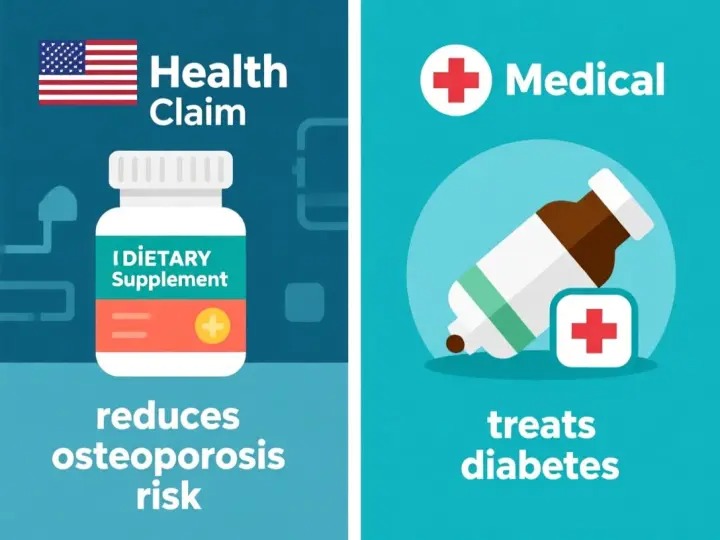
For purposes of medical claims regulation, therefore, we have distinguish:
- Health claims: Statements that verify or suggest a food, a dietary supplement, or a food ingredient component reduces the risk of a disease or a health condition. Examples: “Diets high in calcium reduce osteoporosis risk.” This is also called a disease risk reduction claim. These are allowed under FDA rules, but only when standards are met.
- Medical claims: much stronger. Claims that a product treats, cures, diagnoses, or prevents disease. Drug or medical devices, alone or under strict professional supervision, can do this. If a supplement claims it “heals arthritis” or “cures diabetes,” that’s a medical claim and generally unlawful unless licensed.
The difference between “medical claim regulation” and “health claim USA” is based on the specific phrasing, scientific evidence, and whether it is allowed under FDA/FTC law.
Types of Health & Medical Claims USA: Allowed, Qualified, Disallowed
In U.S. regulation, several categories of claims are relevant. These each have rules: what is allowed, what needs qualification, and what is prohibited.
Authorized Health Claims
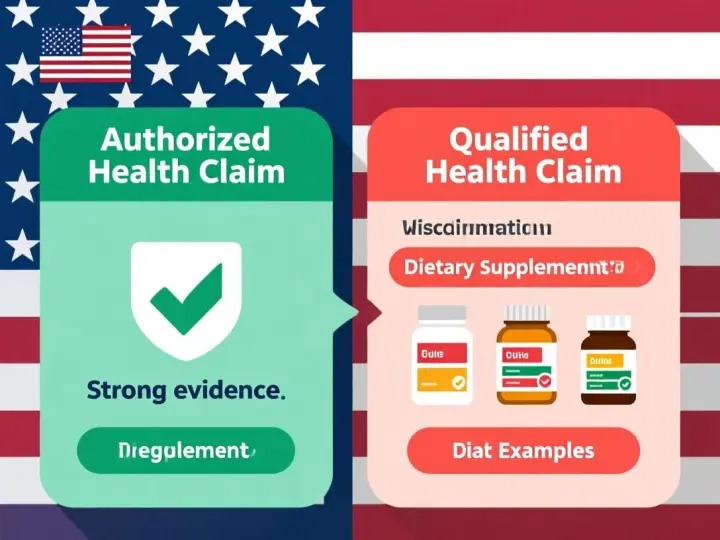
- Authorized health claims are those that have met the FDA’s Significant Scientific Agreement (SSA) standard. Approval for food and dietary supplements takes place when a scientific evaluation based on evidence is sound and provides strong support.
- Sufficient calcium and vitamin D, when incorporated within a balanced diet delivered through physical activity, might reduce the risk of osteoporosis at advanced ages.
Qualified Health Claims
- For weaker or less convincing evidence, the FDA might permit a qualified health claim. These types of claims should contain prominent disclaimers that the evidence is limited or not conclusive. Claim phrasing must avoid suggesting a cure or treatment.
- For example, recently FDA allowed the use of a qualified health statement for yogurt firms that yogurt reduces the risk of type 2 diabetes, with qualifications (serving size, etc.), because of the limitation of evidence.
Claims of Structure/Function and Content of Nutrients
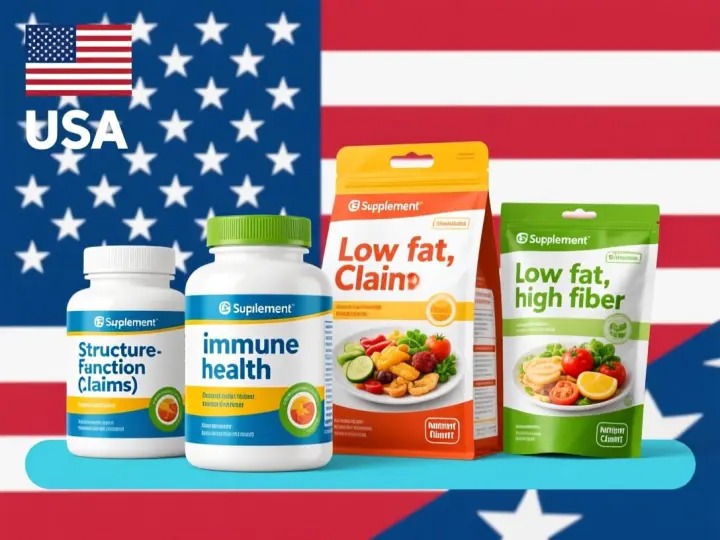
- Structure/function claims are statements of what a supplement or nutrient does structurally or functionally in the body (e.g., “supports immune response,” “helps maintain bone health”). They are not claims of treating or preventing disease. They are managed differently according to the Dietary Supplement Health and Education Act (DSHEA). These kinds of assertions need to be preceded by disclaimers, which are: “This statement has not been evaluated by the FDA. This product is not intended to diagnose, treat, cure, or prevent any disease.”
- Content Claims: Identify the level of a nutrient for a food, e.g., “low fat,” “lower sodium,” “high fiber.” These are regulated via labeling regulations. You have no nutrient content claim when disqualified nutrients exceed a specific quantity for a product.
Disallowed or False/Misleading Claims
- Any claim that promises treatment, cure, or prevention of disease without FDA approval is disallowed.
- Claims lacking reliable scientific evidence or making implied disease claims through imagery or wording are subject to FTC enforcement.
- The case of garlic & cholesterol claim was prohibited by the FDA because not an “authoritative statement” of evidence.
Regulatory Compliance, Claim Substantiation & Enforcement
To ensure that health & medical claims in the USA are truthful, these principles and agencies are key.
FDA Oversight & Claim Regulation
- The FDA regulates health claims in food labeling, requires that health claims (authorized or qualified) be submitted in petition form, and reviewed.
- The FDA also defines rules around nutrient content claims and structure/function claims under DSHEA.
- Proposed updates are pending for certain labeling claims, e.g, revising what qualifies as “healthy” on food labels. The FDA is considering stricter criteria for nutrient content and labeling.
FTC Guidance & Advertising Compliance
- FTC’s Health Products Compliance Guidance (December 2022) updates older guidance and extends oversight over advertising of all health-related products, including supplements, OTC drugs, devices, and apps.
- Key requirement: competent and reliable scientific evidence before making a claim. Not merely small, but pertinent for the formulation, dosage, and target public for the given product.
- Advertising (including social media, packaging, influencer postings) should be honest, not deceptive, and, if there are limitations, should contain prominent and clear disclosures. Even implicitly created claims are actionable if they are likely to deceive consumers.
Enforcement and Legal Penalties
- In case a company resorts to rule violation (misstatement of health, overstated benefit, insufficient substantiation), the FTC or the FDA might issue warning letters, impose fines, request corrective advertising, or ban false claims.
- FTC has already resolved over 200 false or deceptive representations cases for healthy products, dietary supplements, OTC drugs, etc.
Real-World Examples & Recent Changes Under Health & Medical Claims USA
Understanding how these rules work in practice is helpful. Here are some actual cases and changes.
Yogurt & Type 2 Diabetes Qualified Health Claim
- The FDA allowed manufacturers to use a qualified health claim that “eating yogurt regularly (2 cups or 3 servings/week)” may reduce the risk of type 2 diabetes. This is under limited and qualified evidence; thus, specific wording and disclaimers are required.
Garlic & Cholesterol – Disallowed Health Claim
- The FDA prohibited a health claim relating to garlic consumption to decreasing serum cholesterol and cardiovascular disease risk. The evidence was not considered “authoritative” under rules such as FDAMA, so the claim was disallowed.
Risks of Misleading Health & Medical Claims USA
Labeling or advertising false health claims is a serious offense for companies and for clients alike.
- Health Risks: Utilizing unsubstantiated assertions might postpone medically necessary treatment, exacerbate a currently experienced condition, or induce side effects from unnecessary or unsafe items.
- Financial Waste: Money spent on supplements, devices, or “miracle” therapies that yield no beneficial outcome is a financial misallocation. Sometimes, remedial actions based on misinformation are not covered by insurance.
- Legal /Regulatory Risks: There are risks of penalties, lawsuits, fines, and recalls from the FTC or FDA.
- Damage to Reputation & Trust: Deceptive brands stand to lose customers.
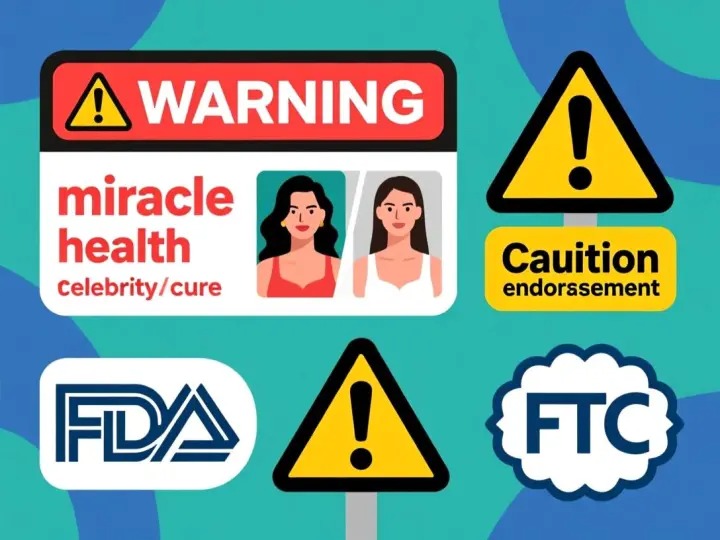
How Consumers Can Identify & Protect Against False Health & Medical Claims
Here are tips for you (in the USA) to judge whether a claim is real and what to do.
- Read the exact claim wording
- Look for “may reduce risk,” “helps support,” rather than “cures,” “prevents.”
- Determine if it is a qualified health claim or an authorized health claim.
- See FDA or FTC oversight/disclaimers
- The packaging and promotion need appropriate disclaimers (“Not evaluated by FDA”, etc.).
- If the claim is qualified, the limitations must be clear and conspicuous.
- Seek out scientific evidence that is trustworthy
- Clinical trials, peer-reviewed journals, human studies, not just testimonials.
- Check whether the evidence uses a similar dosage, formulation, and population.
- Watch out for red flags in misleading advertising
- Overly dramatic before/after images, celebrity testimonials, “miracle cure,” “secret formula,” “instant results.”
- Claims with vague timeframes (“in just 30 days”) or promises of no effort.
- Use official resources
- FDA website (Questions & Answers on Health Claims in Food Labeling) provides information on what claims are authorized.
- FTC’s guidance documents.
- Report misleading claims
- You can file complaints with the FTC (via their website) or notify State Attorney General offices.
- Look up recall notices or warning letters from the FDA.
Future Trends & What to Expect under Health & Medical Claims Regulation USA
As health product marketing and science evolve, so do the rules and enforcement.
- The FDA is working on updating the definition of what makes a food product “healthy,” including nutrient thresholds for “healthy” labels. New “healthy” claim rules expected by 2028.
- More scrutiny on apps, wellness devices, and home diagnostics making health claims. They may face both FDA device regulation and FTC advertising rules.
- Higher expectations for openness regarding research, and harder human trials than laboratory/animal experiments.
- More regulatory and legal actions against companies for false health claims, increasing public interest, and consumer demands.
Conclusion: Key Takeaways on Health & Medical Claims USA
- Health claims in the USA are regulated tightly: authorized vs qualified claims, nutritional & structure/function claims, all with legal rules.
- Drugs (healing, treating a condition) have medical claims primarily for FDA-approved drugs and medical devices; using them otherwise is unlawful.
- It is always advisable to verify if a statement is supported with sound scientific evidence and check if there are disclaimers.
- Use legitimate sources, be cautious of outlandish assertions, and familiarize yourself with your consumer protection laws.
Adherence to such principles shall prepare one to be able to discern between true and false health and medical claims, protect one’s own health, and escape deception.
Frequently Asked Questions (FAQs)
Retaliation involves disciplining employees for either reporting discrimination, hazardous working conditions, wage violations, or simply participating in investigations.
These include filing complaints, requesting FMLA leave, seeking disability accommodations, and reporting unsafe or illegal practices in the workplace.
Show that you engaged in a protected activity, that you had an adverse action, and the action was because of your protected activity. Supporting documentation can include emails, performance evaluations, or a witness statement.
Usually, you would be required to file with the EEOC or the Department of Labor within 180–300 days, depending on the type of claim and your state.
Potential remedies may involve back pay, front pay, reinstatement, damages due to emotional distress, punitive damages, and, if the claim is valid, recovery of attorney fees.