

Introduction
Long hours without reasonable overtime compensation could be stressful and infuriating. Long hours for American workers mean working beyond deadlines, supporting their families, or helping their employers, but all might not earn wages that they legally deserve.
If your employer failed to pay you the right wages for the wages worked, you might bring an overtime wage claim for the violation of the Fair Labor Standards Act (FLSA).
This in-depth guide shall show you what the FLSA requires when it comes to overtime pay, who is eligible for it, and how to compute overtime wages, and even show how to make a case if your employer wrongfully denied your rights. Everything is in regular, easy-to-read English, so all workers may comprehend their rights and act appropriately.
What is an Overtime Wage Claim?
An overtime wages lawsuit is an official lawsuit or complaint initiated by an employee for non-payment of earned overtime wages from their employer.
Fair Labor Standards Act (FLSA), enacted in 1938, was the federal act that established the federal minimum wage rate, overtime rate, record-keeping, and child protection for workers.
Under such law:
- Employees will normally have to work 1.5 times their regular rate of pay (“time and a half”) for all hours worked beyond 40 in a week of work.
- The law applies to all of the private sector firms and the federal, state, and city governments.
If your employer did not pay you at the proper rate of overtime or tried to deny you overtime in hopes that he could avoid your wages, you would have the right to file a wage and hour lawsuit in an effort to obtain your owed wages and damages.
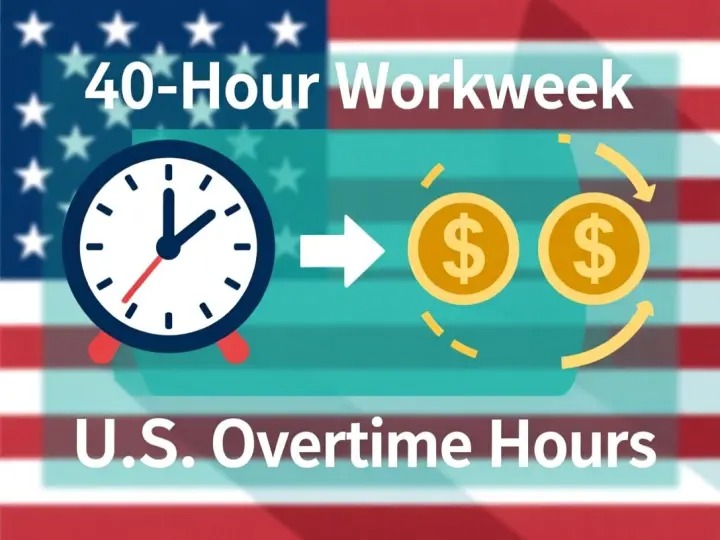
Why the Fair Labor Standards Act (FLSA) Matters
The FLSA shields millions of American workers from exploitation through the following means:
- Staff are duly remunerated for worktime.
- Employers maintain current records of pay and hours.
- They may submit claims for violations of their rights.
The FLSA is enforced throughout all 50 states, yet most states have their own overtime statutes that provide even greater protection.
For instance:
- California mandates daily overtime after 8 hours worked in one day, but the FLSA is based on working hours in one week.
Knowing your rights under the FLSA is only the first step towards demanding what is owed to you.
Who is Covered Under Overtime Pay?
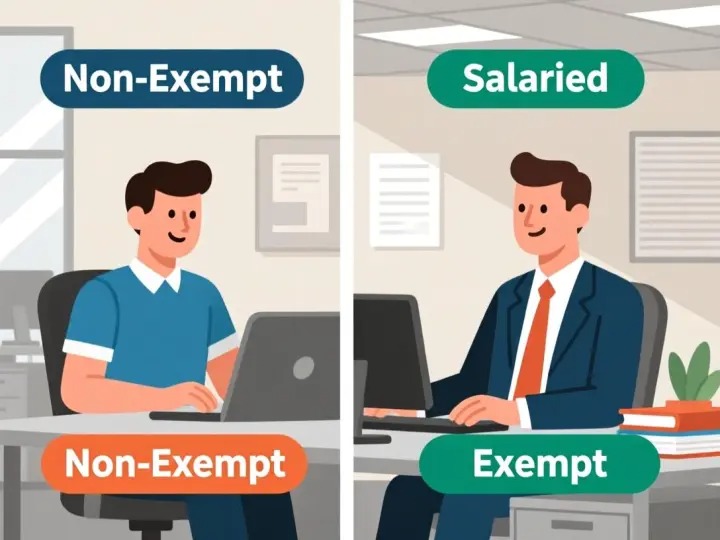
Not all workers are entitled to overtime for wages under the FLSA. The law divides workers into two groups:
1. Nonexempt Employees
These employees are entitled to overtime wages.
The majority is composed of hourly workers.
- They should get at least the federal minimum wage (this year, 2025, minimum is now up to $7.25/hour).
- 1.5 times their regular rate for all hours worked beyond 40 in one week.
2. Exempt Employees
These workers do not earn overtime wages. They would otherwise be salaried workers who meet select job duties and minimum wage thresholds set forth in the FLSA.
Examples of regular exempt positions are:
- Management Staff (Executives, managers
- Administrative workers (office professionals)
- Specialized workers (lawyers, doctors, mechanical
- Outside sales reps
- Computer professionals earning above a specific salary threshold
Also, just because you’re salaried does not necessarily mean you’re automatically exempt. Exemption is based on actual job responsibilities and level of pay, not job description.
Frequent Excuses Why Employers Deny Overtime Pay
Numerous employers do not pay for overtime due to indulging in illegal or unfair methods. Some of the significant reasons why employees initiate overtime wage lawsuits are:
- Misclassification: Calling hourly workers “salaried” or “independent contractors” in order to deny overtime.
- Off-the-clock work: Asking workers to work prior to or after working hours.
- Omission of bonuses or commissions: Regular rate shall include all nondiscretionary bonuses, commissions, and incentive pay.
- Rounding time unjustly: Rounding down work hours so workers seem to have less time worked.
- “Comp time” in lieu of wages: Non-public employers that provide time off in lieu of overtime pay (which is prohibited under the FLSA).
If any of these is your case, your employer could potentially violate federal law—and you have rights.
How to Calculate Your Overtime Pay
Understanding the calculation of overtime pay allows you to recognize underpayment and prepare for your claim.
Step 1: Identify your regular rate of pay
Your “regular rate” is all wages for the week (piece rate, hourly, commissions, bonuses) divided by all hours worked during the week.
For Example:
Since you earn $800 in one week, working for 40 hours, $800,
your average rate = $800 ÷ 40 = $20/hour.
Step 2: Calculate All Hours Worked
Count all of the hours that you have worked
- Work that was performed prior/post-schedule
- Work hours on phone calls/e-mails from home
- Even training that was compulsory
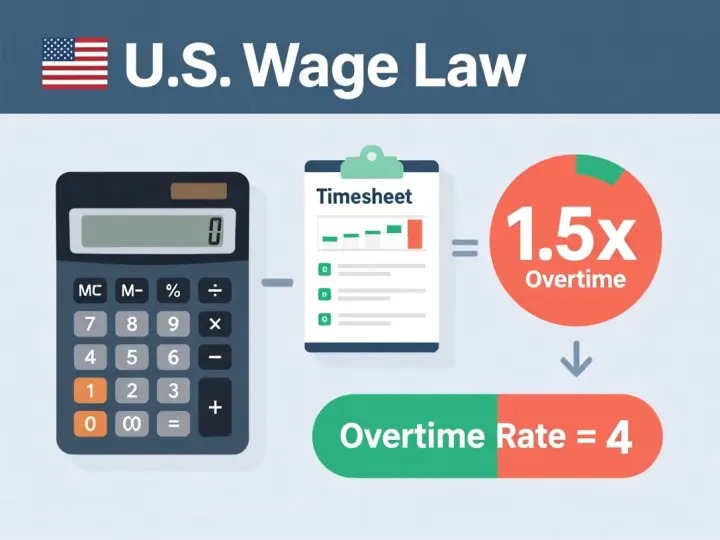
Step 3: Overtime Hours Times 1.5
For every hour beyond 40 in your week, your rate is times 1.5.
Illustration:
Given that you had worked for 48 hours in the week, and your rate is $20/hour
Overtime = 8 hrs × (20 × 1.5) = 240 overtime pay.
Step 4: Look for Bonus or Reward
In addition, if you received bonuses or commissions, they must be included in your regular pay in order to calculate your regular rate.
Examples:
If you received bonus money of $100 for that week, put it in your pay before calculating overtime.
Guidelines for Filing an Overtime Wage Claim
If your employer didn’t pay you right, this is just what you should do:
Step 1: Assemble all the evidence
Collect evidence that you have worked overtime and weren’t compensated in accordance:
- Pay slips and time sheets
- Email, text, or calendars specifying your hours
- Employment handbooks or contracts
- Witness accounts (coworkers could help to confirm
Organize these—increase your chances of a winning argument with strong evidence.
Step 2: Discuss With Your Employer (Optional)
At times, overtime is unpaid due to an error.
You raise the issue initially with your manager or HR.
If he/she doesn’t fix it, proceed to the second level.
Step 3: Complaint to the U.S. Department of Labor (DOL)
You may initiate a sworn wage complaint to the DOL’s Wage and Hour Division (WHD)
That’s why:
- Phone your DOL office or stop by it.
- Register online or by mail (application forms may be obtained from dol.gov).
- Include all pertinent details: your employer’s name and address, your job, method of pay, and documentary evidence of unpaid overtime.
Once you’ve filed, the DOL will investigate your case. They may interview you and your employer, review your payroll records, and make up their mind just how much overtime you’re owed.
Step 4: Seeking Private Lawsuit (When Necessary)
If the DOL doesn’t resolve your case or you prefer direct legal action, you can file a lawsuit in federal court.
With a lawsuit, you can potentially collect:
- Back pay (wages for overtime worked)
- Liquidated damages (amounting to an equal sum of your unpaid wages)
- Attorney’s fees
- Court expenses
You could also organize with other workers in a group lawsuit if more workers were UNDERPAID.
Step 5: Be aware of Deadlines (Statute of Limitations)
With the FLSA:
- You may collect unpaid overtime for up to 2 years prior to that.
- If the employer’s violation was willful, that is, deliberate, you may ask for up to 3 years’ back pay.
Reply Promptly: Waiting may diminish the dollar amount that is recoverable.

What You May Recover in an Overtime Wage Claim
When you file an honest overtime pay case, you could win:
- Unpaid Overtime Wages: All unpaid overtime that you have worked.
- Liquidated Damages: Usually equal to your back wages (so you get twice that much).
- Interest: On deferred payments.
- Attorney’s Fees: So you do not have to pay from your own pocket.
- Policy Changes: You could have the court force your employer to end illegal pay practices.
Examples:
You could receive up to $10,000 in total with liquidated damages and attorneys’ fees if you owed $5,000 in back overtime wages.
Common Mistakes Employees Make
Many workers lose legitimate overtime claims because of preventable mistakes that they commit. These are the following:
- Keeping no records: Although your employer is supposed to record hours, keep your own records as well.
- Presumes salary: Salary in itself doesn’t mean that you owe overtime.
- Missing the deadline for filing: Always move quickly; time is of the essence.
- They might only rely on the employer’s testimony: HR won’t necessarily disclose your whole rights.
- Except for bonuses or commissions: They alter your regular rate and your overall pay.
- Failing to consult an attorney: Labor laws may be intricate a wage lawyer may make your case more valuable.
Recent Trends and Jurisdictional Decisions
FLSA was clarified by court rulings and Labor Department amendments:
- E.M.D. Sales, Inc. v. Carrera (2025): Held that employers had the burden of proof in proving an exemption when overtime pay is denied.
- DOL Overtime Rule Changes: The Labor Department is in perpetual flux in its minimum salary requirements for exempt employees. In 2024 decision upheld that salary levels could establish overtime eligibility.
- Regular Rate Modernization: The DOL updated the regulations to include certain bonuses and benefits in the regular pay determination.
Staying current helps workers and employers with duties and rights.
How to Protect Yourself Against Overtime Violations
Even if you would never make any sort of claim, you could do things that would cover you:
- Clock your hours every day: Maintain your own beginning and end time sheet.
- Save all paychecks: They show your pay and your deductions.
- Know your classification: Request from HR if you’re nonexempt or exempt and why.
- Know your company’s overtime policy: It has to align with the FLSA.
- Speak up early: Report problems soon to avoid huge unpaid balances.
- Consult an attorney: Especially if your employer retaliates or ignores your claim.
What to Do If Your Employer Retaliates
It is illegal for your employer to do anything in retaliation for your lawsuit for overtime pay.
Retaliation may involve:
- Terminating or demoting you
- Decreasing your hours
- Unfairly scheduling your schedule
- Harassing or threatening you in your workplace
In such instances, notify the Department of Labor’s WHD or file a stand-alone retaliation lawsuit. Retribution, back pay, and other damages may be awarded by the court.
State Overtime Act vs. Federal Act
Federal Act
Though the FLSA is the federal minimum, more states have higher levels of protection:
- California: 8-hour daily overtime, twice the rate after 12 hours.
- New York: Overtime for selected sectors and workers who earn hourly wages.
- Texas and Florida: They follow federal FLSA regulations but do provide for local enforcement.
Employees never have any right to whatever law is less beneficial, whether federal or state.
Conclusion
Your time is worth money, and the law makes sure that you’re paid for it.
If your employer is not paying the right wages for overtime, it is your right to seek legal remedy under the Fair Labor Standards Act.
Bringing an overtime wage claim is not only about recovery of your lost funds back it’s also for asserting your right to fair treatment in your workplace and safeguarding your future earnings.
Whether it is with the Labor Department or in an individual lawsuit, remember:
Write in detail.
- Act quickly within the deadline.
- Fear not, the law is with you.
- Obtain professional guidance if in doubt.
Equal pay for equal work is not a privilege; it’s your federal right.
Frequently Asked Questions (FAQs)
Any non-exempt employee who has worked over 40 hours in a workweek without proper overtime compensation, even though salaried, may submit a claim.
No, a salary will not automatically exempt an employee from overtime entitlements. Exemptions are based on job duties and compensation level.
Time counted includes all hours worked, off-the-clock work, required training, work-related emails and calls, and any additional time before or after shifts worked.
Under federal law, one can typically recover unpaid overtime for up to 2 years, or up to 3 years if the employer’s violation was willful.
No. Retaliation is illegal. An employer may not discharge, demote, or otherwise harass an employee for asserting rights to overtime pay.
[…] overtime or violation of minimum […]