

Introduction
There are a few legal rights for workers in the workplace in the United States. You have the legal right to work at a workplace that is fair, safe, and non-discriminatory. You have the legal right to report unfair treatment, unsafe practice, or illegal activity at work without being punished for filing such a report.
But at times, when the employee complains or expresses a concern, rather than addressing the issue, the employer might punish the employee for raising the concern. This is called retaliation.
The retaliation lawsuit is a case the employee may file when he or she is punished, fired, or mistreated for filing something unlawful or for exercising their workplace rights. It is, nonetheless, difficult for a person to substantiate employer retaliation. This requires proper knowledge of how retaliation functions, what evidence matters, and what legal remedies there are.
This paper walks you step-by-step through how to demonstrate workplace retaliation. This outlines what your legal rights are under American law, what evidence you’ll require, and how to take the correct legal steps if your employer has wrongly punished you.
What Is Employer Retaliation?
Retaliation by an employer is when your boss or employer punishes you for engaging in a legally protected activity.
A “protected activity” might, for instance:
- Be a complaint for discrimination,
- A report of unsafe workplace policies,
- A medical leave, or
- A cooperation with a workplace investigation.
For instance:
- If you complain of sexual harassment and then are demoted, that’s retaliation.
- Whether you complain about not being given overtime pay and then your hours are cut, that’s retaliation.
- If you complain on a fellow worker’s behalf for being discriminated against and then receive substandard performance reports, that constitutes retaliation, too.
It is illegal under Federal law for employer/s to “get back at” you for advocating for your own legal rights or for assisting others for the same.
Major Federal Statutes that Provide Protection against Retaliation
Several major federal laws protect workers from retaliation in the U.S:
Title VII of the Civil Rights Act of 1964: This protects employees who complain or object to race, sex, religion, color, or national origin discrimination.
Age Discrimination in Employment Act (ADEA): Protects employees above 40 from retaliation after they have claimed age-related discrimination.
Americans with Disabilities Act (ADA): Protects workers who request accommodation for disability or report disability discrimination.
- Family and Medical Leave Act (FMLA): Covers employees who take or request medical leave for a relative or themselves.
- Safeguarded under the Fair Labor Standards Act (FLSA): protected aggrieved workers who allege pay or overtime exploitation.
- Occupational Safety and Health Act (OSHA): Protects workers from disclosing unsafe working places.
Statutes for Protection of Whistleblowers: Protect workers who report fraudulent activities, corruption, or crime.
Such laws are administered at the federal level by offices such as the EEOC (Equal Employment Opportunity Commission) and the DOL (U.S. Department of Labor). A majority of states have a collection of laws as well, which provide extra protection.
Examples of Employer Retaliation

The employer could retaliate in a variety of ways, obvious or not so obvious. Here are the most common case scenarios:
- Being fired or discharged for raising a complaint
- Being demoted or moved into a less prestigious position
- Sudden pay cut or cutting down on work hours
- Receiving unjust performance ratings after raising a complaint
- Being left out of training sessions or conferences
- Dealing with Increased Supervision or Notification from Management
- Facing bullying or harassment from colleagues or bosses
- Not getting promotions or advantages
- Being intimidated or threatened for helping with the investigation
Even if you haven’t been released, any action that might make a prudent worker hesitant to complain might be deemed retaliation.
What Is a Protected Activity?

It means a legal activity that a worker does while being protected under federal or state law coverage. There won’t be punishment for such activities.
Covered activities are:
- Reporting a case of harassment or discrimination (with or within the EEOC)
- Testifying on behalf of some other person
- Reporting a wage or hour violation
- Grievance for unsafe work condition
- Requesting disability accommodation
- Taking or asking for medical leave (under FMLA)
- Reporting illegal company actions or fraud
- Participating in workplace investigations
If you do, and your employer subsequently takes adverse personnel action against you, that is a strong evidentiary demonstration of retaliation.
How to Show Retaliation – Step-by-Step Explanation
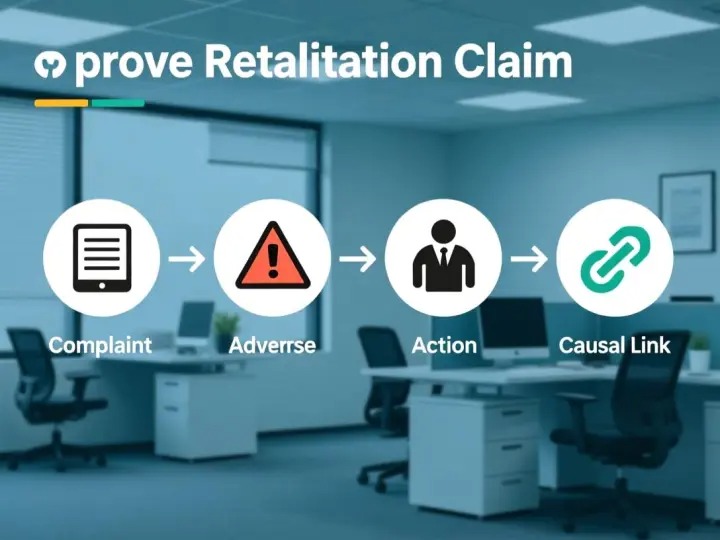
To prove a retaliation claim, you must demonstrate that three main things happened:
- You had participated in a covered activity.
- Your employer took an adverse employment action against you.
- There exists a causal relationship between the protected activity and the actions of the employer.
It is worth explaining them stepwise:
Step 1: Record That You Engaged in Protected Activity
First, prove that you did something the law is there for.
This might be as easy:
- As emailing HR a complaint of discrimination
- Writing a formal complaint to the EEOC
- Even casually mentioning the harassment to your boss.
Key points for reflection:
When the activity did occur (date/time).
To whom you reported it (supervisor, HR, agency).
What happened (discrimination, safety violation, withheld pay, etc.).
How you reported it (email, in-person, written complaint).
Example:
On 1st May, you report to HR that your supervisor makes discriminatory remarks with respect to your religion. On 10th May, your supervisor cut your working hours down by 30%.
That 9-day lapse and abrupt punishment demonstrate a likely link that’s what makes a retaliation claim compelling.
Step 2: Demonstrate That You Experienced an Adverse Employment Action
Adverse employment action consists of anything that has a detrimental impact on your workplace or on your employment.
Such as:
- Termination or dismissal
- Salary decrease
- Transfer of occupations to a lower rank
- Demotion
- Suspension
- Negative comments
- Refusal of promotion or emoluments
The underlying idea is that the grievance had better be about something concrete — consequential enough to make a second employee hesitant about complaining.
Example:
You complain of working overtime at the Department of Labor. After two weeks, your boss gives you the toughest shifts, does not invite you to team conferences, and does not send you for training programs.
All such changes are retaliation because they negatively impact your working life and probably would make you less likely to complain again.
Step 3: Verify the Association between the Two
This is generally the toughest step. You need to demonstrate that your employer unjustly punished you because you participated in a protected activity, for some other reason than that.
These are some common ways of showing that relationship:
- Timing (proximity in time): If punishment happens soon after your complaint, it’s good proof of retaliation.
- Changing reasons: If your employer shifts their explanation concerning why they punished you, then that’s fishy.
- Comparative treatment: Show that other workers, who had not complained, had been better treated.
- Statements or Conduct: any hostile or threatening speech from supervisors will help prove intent.
- Behavioral pattern: If there is a history on the part of the company of punishing aggrieved workers, then that helps your case.
Example:
You complained about gender discrimination. A week later, your boss told you, “Maybe you shouldn’t stir things up if you want to keep your job.” Shortly after, you were written up for “poor teamwork.”
Such a direct statement is a clear indication of retaliation.
Step 4: Employer’s Explanation Is a Pretext Excuse Only
After presenting your argument, your employer will probably respond that they did what they did for justifiable reasons — for instance, poor performance, restructuring, or bad behavior.
Your task is to show that this reason is just a pretext, a fake excuse to hide the real retaliatory motive.
Pretext can be proved by showing:
- The employer’s excuses are conflicting or have evolved over time.
- They have no proof for their solution.
- The other workers did the same but were not fired.
- Your performance was good until you had a complaint.
- The punishment follows directly after your complaint.
Example:
Your performance has been superb for a period of three years. A month after you complain of sexual harassment, your supervisor declares you “not meeting expectations.” There is no evidence, and no other employee was sanctioned for the same misbehaviors.
This circumstance would highly indicate pretext and retaliation.
Gathering Evidence for Your Retaliation Claim
Evidence is the foundation of a successful case of retaliation. You must have a method of substantiating what happened with tangible documents.
Here’s what you should collect:
- E-Mails und Nachrichten: Speichern Sie alle E-Mails und Nachrichten, die mit Ihrem Vorfall bzw. Diszipl.
- Performance Reviews: Keep copies of earlier reviews for reference when demonstrating performance enhanced following a complaint.
- HR Reports: Maintain on file your formal complaints, investigation findings, and follow-ups.
- Witness Statements: Interview witness workers who have heard or witnessed cases of retaliation.
- Schedules or Work Assignments: Record shifts that happened during your protected activity.
- Pay Records: Show any withheld pay or denied raises.
- Employer Policy: If your employer violated its own disciplinary policy, that’s a good indication.
Never leave documents anywhere inside your workplace PC or e-mail. If at all, keep them on your own PC or e-mail.
Retaliation Complaint Filing at Work in the US.
If you think your employer acted illegally in your case, here is how you officially go about:
Internally:
Report the retaliation to your company’s HR staff or senior management. Internal grievance, at times, resolves the issue immediately.
Bring a Complaint to EEOC or DOL:
- For retaliatory discrimination, call the EEOC.
- For retaliation for pay or safety, call the Department of Labor (Wage and Hour Division or OSHA).
You have between 180 and 300 days from when you have been retaliated against to file your complaint.
Assist with Investigation:
They may call your employer, request papers, or interview witnesses. Be on time, truthful, and frank.
Promise Not-to-Sue Letter:
If the EEOC does not succeed with your case, it will send you a “right-to-sue” letter, enabling you to
Call a Labor Attorney:
An experienced attorney familiar with retaliation cases can consult you, negotiate for you, and sue on your behalf when needed.
Lawsuit Process:
In the courtroom, your attorney will submit your evidence to establish retaliation. If you are successful, you are able to recover for your damages.
What Are Recoverable Damages for a Retaliation Suit?

If you succeed on your retaliation claim, you might recover various kinds of compensation:
- Back Pay: The pay or compensation that you have lost because of retaliation.
- Front Pay: Payment for future lost wages if reinstatement is not desired.
- Reinstatement: Restoration of your promotion or employment.
- Emotional Distress Damages: For distress, humiliation, or emotional damages.
- Punitive Damages: If the employer’s conduct was particularly dishonorable.
- Attorney Fees and Court Costs: Reimbursement of your legal costs.
Policy Amendments: Courts have the power to compel employers to enhance workplace practices.
Pitfalls to Avoid When Supporting Retaliation Claims
- Not recording incidents: Always maintain a written record of events.
- Missing deadlines: Complaints should be filed at EEOC or DOL within 180–300 days.
- Dependence on proof based on words alone: Written proof is much more convincing.
- Not seeking a lawyer: Professional legal assistance is vital for difficult cases of retaliation.
- Leaving too early: Leaving too early without pursuing a lawsuit might ruin your case.
How to Guard against Future Revenge
- Retain copies of all correspondence at the workplace.
- Be professional and collected, even if you are mistreated; don’t give your boss a reason.
- Read everything down in a personal journal or timeline.
- Know your rights, acquaint yourself with company policies and federal regulations.
- Obtain legal information prior to signing anything (e.g., settlement agreements).
Conclusion
It takes proof of a retaliation claim to demonstrate the whole picture that you acted responsibly in raising a concern, and your employer sought retaliation for doing so.
Knowing what constitutes a covered activity, what constitutes an adverse employment action, and documenting diligently through the steps, you establish a strong case.
The highest-performing retaliation claims enjoy strong evidence, time-verifiable time frames, and experienced legal assistance. If you think employer retaliation has been leveled against you, don’t remain silent. Call a lawyer who deals with employment law, the EEOC, or the Department of Labor today.
You have rights, and the law is on your side.
Frequently Asked Questions (FAQs)
Retaliation is when an employer punishes an employee for reporting discrimination, unsafe working conditions, wage violations, or for taking part in investigations.
These activities include, but are not limited to, filing complaints, requesting family medical leave, seeking accommodations due to disability, and reporting practices unsafe or illegal in the workplace.
Then, show that a protected activity took place; an adverse action occurred; and the action is related to the protected activity. Furthermore, supporting evidence needed could be emails, performance evaluations, and statements from witnesses.
Generally, a charge must be filed with the EEOC or the Department of Labor within 180–300 days after the retaliation, depending upon the type of claim and which state is involved.
The possible remedies might include back pay, front pay, reinstatement, compensatory damages for emotional distress, punitive damages, and attorneys’ fees if the claim is successful.
[…] governed by the so-called “at-will” doctrine of employment, meaning essentially that an employer retains the privilege to dismiss an employee any time, due to nearly any cause that comes up, or […]